ChatGPT vs Claude vs Google Gemini: Which AI Chatbot is Best?

The arrival of AI has revolutionized the operations of writers, developers, SEO professionals, agencies, and teachers. There has been a wave of competition since Nov. 30, 2022, when ChatGPT was launched, compelling companies to upgrade their tech. Google launched Bard AI, later rebranded as Gemini, and Anthropic launched Claude AI.

Initially, both did not work out, but they have improved by leaps and bounds over time. These chatbots now can aid in searching, debugging CSS, and even creating robots.txt files. They can also aid in topic generation, allowing users to create emails, newsletters, and blog posts efficiently. ChatGPT vs Claude vs Google Gemini: Which AI Chatbot is Best?

All platforms now claim to provide the most accurate and concise responses. The market is filled with hype, and it is hard to pick the best one. ChatGPT was ahead at first, but the interface of Claude AI and the release of Claude 3.5 Sonnet have made people excited. Google-supported Gemini has improved vastly. These computer chatbots are presently neck and neck, and each of them is vying for dominance and preeminence. The question is: who is actually leading?

Exploring Claude’s Capabilities and Features

Claude, developed by Anthropic, has been making the rounds with its minimalist and classy design. With respect to its contemporaries, ChatGPT and Gemini, it delivers uncomplicated results in a minimalist framework. The program works similar to other AI aids, wherein one can input, copy, recite, and even files to be uploaded (30 MB with a cap at 5). It provides suggestions, recent conversations in the sidebar, and functionality like starred messages to track long projects. The light and dark mode can also be toggled or experimental features accessed using the feature preview section. The artifacts feature stores generated content in another screen so that users can handle long conversations more comfortably.

  • There are three versions to choose from: Haiku, Sonnet, and Opus, each optimized for varying capabilities.
  • Has a very wide context window of 1,000,000 tokens, which makes it ideal for detailed, large-scale data inputs and deep analysis.
  • Has expert models that are good for rapid answers, profound logic, and extracting data.
  • Achieves successful coding, OCR, and image-based data extraction in giving accurate, reliable outputs.
  • Focuses on ethical AI procedures with strict safety adherence to interaction and low rates of refusal as well as small biased outputs.
  • Offers pricing packages:
  • Haiku – $0.25 per million input tokens, $1.25 per million output tokens.
  • Sonnet – $3 per million input tokens, $15 per million output tokens.
  • Opus – $15 per million input tokens, $75 per million output tokens, available within Claude Pro for $20/month.

Exploring Gemini’s Features and Functionalities

Gemini, created by Google, is like a higher-level version of Google Search in terms of informative, detailed responses. Unlike most AI assistants, it proactively searches the internet, offers proof, and even generates images from text inputs. One of its best features is the double-check response, with which users can check sources on Google search. It also has the widest context window, retaining minute details—a great boon for long-term assignments. Moreover, Gemini extensions fluidly connect with Google Maps, YouTube, Flights, and Hotels, promoting cross-platform usability.

  • Supports multimodal AI, processing text, voice, and image as inputs for diverse applications.
  • Provides in-depth integration with Google applications such as Docs and Gmail, suitable for productivity users.
  • Does well in language features, offering support for numerous languages for global use.
  • Delivers real-time response, useful for customer support and interactive apps.
  • Comes in various versions, such as Gemini 1.5 Flash, Gemini 1.5 Flash-8B, Gemini 1.5 Pro, and Gemini 1.0 Pro, each meant for different performance levels.
  • Found in a free version with basic features, whereas the paid version ($20 a month with Google One) offers access to new AI models and other Google services.

ChatGPT – Advanced AI with Customization and Versatility

ChatGPT, created by OpenAI, was one of the earliest AI assistants, launched in November 2022. It has undergone significant updates since then, with text and image creation, data analysis, and personalized AI models. The simplicity of the chat interface provides an easy experience, without any extra clutter. Though it used to have a reputation for giving imprecise answers, its recent updates make it much more precise and effective. Plus and business users can even build personalized GPTs, tailoring AI interactions to individual requirements.

  • Supports text and image generation.
  • Allows file uploads, making it well-suited for data analysis, content creation, and bespoke AI solutions.
  • Adaptable to customer service, technical writing, creative work, and beyond.
  • Includes ChatGPT Search, which combines AI chat with web browsing for live information.
  • Offers Canvas, isolating AI chat from output generations for more effective iteration.
  • Free tier is available with GPT-3.5, while the premium tier ($20/month) adds GPT-4 and GPT-4o.

Overview of Chatgpt vs Claude Vs Gemini

Here’s a table summarizing the key features, capabilities, and pricing of ChatGPT, Claude, and Google Gemini:

Feature ChatGPT (OpenAI) Claude (Anthropic) Gemini (Google)
Launch Date November 30, 2022 Developed by Anthropic Initially Bard AI, rebranded as Gemini
Interface Modern, user-friendly, uncluttered Minimalistic, clean, and sophisticated Feels like Google Search, evidence-based
Core Capabilities Text & image generation, data analysis Straightforward results, file uploads Web search, AI-powered image generation
File Upload Support Yes, allows analysis and chart creation Yes, up to 30MB, with a limit of 5 files Limited
Customization Custom GPTs for enterprise users Starred messages, long project tracking Gemini extensions for Google services
Coding & Debugging Assists in debugging and generating code Excels in OCR and image data extraction Helps with fixing bugs and coding tasks
Search Capabilities ChatGPT Search for web browsing No direct web search Double-check responses with Google Search
Special Features GPT Store, Canvas for iterative output Artifacts feature for content management Longest context window, remembers details
AI Model Versions GPT-4o, GPT-4, GPT-3.5 Turbo Haiku, Sonnet, Opus Gemini 1.5 Flash, 1.5 Flash-8B, 1.5 Pro, 1.0 Pro
Best Use Cases Customer service, creative writing, research Large-scale analysis, in-depth reasoning, ethical AI Productivity, real-time search, multilingual support
Pricing (Free Tier) GPT-3.5 available for free No free tier Basic version free
Pricing (Paid Tier) $20/month (GPT-4, GPT-4o) Haiku: $0.25 per million tokensSonnet: $3 per million tokensOpus: $15 per million tokens ($20/month for Claude Pro) $20/month (Google One, access to latest AI models)

Conclusion

Among the selection of ChatGPT, Claude, and Gemini, each AI chatbot has unique strengths tailored to different needs. ChatGPT stands out for customization, content generation, text and image creation, file uploads, and real-time search, making it ideal for content writers, developers, and businesses seeking a versatile AI assistant.

Claude is known for ethical AI, a clean interface, and advanced reasoning capabilities, making it highly effective for large-scale analysis and complex data processing.

Gemini, powered by Google, is best suited for web-based research, real-time search, and productivity thanks to its deep integration with Google services. Pricing varies, with ChatGPT and Gemini offering relatively affordable paid plans, while Claude follows a more token-based pricing approach.

For businesses looking to turn AI capabilities into scalable digital products, companies like CoderKod provide AI-powered software development services, helping organizations integrate automation, intelligent systems, and custom software solutions into their workflows.

In the end, the best AI assistant depends on your workflow, customization requirements, business goals, and budget.
Is Online Advertising Really Worth the Cost?

I have worked across multiple industries while running SEO and paid advertising campaigns and gained direct knowledge about marketing platforms’ performance levels and associated costs. 

Online advertising provides clients with unexpected cost efficiency that greatly exceeds offline advertising expenses. In 2025, the online market will continue to reach 1,000 people for only $3-$10. Traditional advertising methods usually begin at $22 and beyond, whereas online advertising starts under $10 to reach 1,000 potential customers.

Digital strategies such as SEO and paid advertising demonstrate both high tracking capabilities and powerful results during targeted vertical engagement. Online advertising provides businesses with an economically attractive approach to measurable outcomes in the advertising market. 

The handsome investment returns from multiple campaigns continually indicate that this method provides excellent cost-effectiveness. When used by businesses of all budget levels, this method proves reliable and contextual to current marketing standards. The transition from offline to online advertisement has become more apparent than ever before and will continue this way through 2025.

Breaking Down Real Advertising Costs in 2025

Users seeking online advertising costs initially need to view online marketing expenses relative to traditional advertising spending. The traditional marketing channels maintain their validity, yet online marketing provides enhanced control, together with better flexibility. 

Today’s businesses can connect with their perfect prospects through multiple existing media channels, which provide better engagement opportunities. My experience working with client campaigns reveals significant price diversity in the fees. 

Our internal research indicates that typical cost metrics between $3-$10 function as thresholds for each thousand impressions, and the average cost per click falls between $1 to $3. One important fact about these price statistics is that they multiply rapidly based on targeted strategy implementation.

Our organization researched standard costs across prominent online advertising platforms to obtain current operational expenditure information. The analysis used concrete results to present CPM and CPC data at their most straightforward level. 

Your budget size affects nothing when using these models because they allow you to optimize campaigns while extracting maximum value from your advertising investments. My take? The proper advertising plan, combined with testing capabilities, enables companies to adjust while minimizing budget waste.

GOOGLE ADVERTISING Cost

What Search Ads Cost in 2025

At present, I oversee many marketing campaigns that show that Google Ads Search Advertising Costs respond to business service types, along with audience buying intent. Your cost per click will be $2.32 as a benchmark, yet diverse keyword bids determine actual expenses at different levels. The minimal search advertisements display instantly for users who scan Google search results for information about your offered products or solutions. The strength of these ads lies in their precision because your advertisements appear just when prospective customers need your available products or services. The campaign delivered 30 site visitors from $38.40 CPM ($38 per 1,000 viewable impressions,) where we collected several sales leads and actual transactions.

Search operations provide exceptional precision to users because of their advanced capabilities. People see your ads because they precisely reflect what users express as their search interests at present. Your business needs to be present during the buying or comparison phase since users will make better decisions with your involvement. The most successful campaigns use advertising content that directly matches the specific search terms of prospects and aligns with precise keywords. Google Ads excels because it allows you to join services you provide with users needing them precisely when they search.

YouTube Ads & the Power of CPV in 2025

YouTube Advertisers function on a Cost-per-view system, different from Google search advertisements. Because YouTube works on Cost Per View (CPV), clients initially try to equate this system with CPM, even though they are distinct from one another. The engagement levels within a video ad determine the variable cost increase, according to my experience. 

You will spend around $100 to get a thousand viewers who watch your YouTube Ads since each view costs approximately $0.10 on average. People watch your ads actively because they desire to see them suggesting genuine value compared to involuntary exposure.

The CPM cost reaches a minimum of $9.50 during the initial 5 seconds of a YouTube ad, provided the content is either outstanding or extremely poor. Unfortunately, an average of $100 will be your expense for every thousand voluntary views of your well-optimized advertisement. 

The average CPC price for click-focused results amounts to $3.21, but maintaining focused target demographics can still deliver effective cost performance. YouTube allows businesses to use the video format successfully to create emotional connections while providing performance-based pricing through its strategic approach.

Social Media Advertising Costs

Facebook Advertising Costs in 2025

The biggest advantage of using Facebook for online advertisement is its capability to adapt budgeting choices according to your needs. Facebook advertising provides users with two budgeting options: daily and lifetime allowances, so advertisements align with every marketing strategy. 

Facebook allows businesses to start advertising with minimum spending of just $1.00, which constitutes a suitable entry solution for businesses of varying sizes. Clients using Facebook’s platform benefit from the platform’s capabilities, which distribute ads to Instagram Messenger and the Facebook Audience Network along with Facebook. A wide-reaching advertising system allows you to achieve maximum visibility using minimal-budget spending methods that access large audiences.

Instagram Ads vs Facebook Ads: Cost and Performance

Facebook maintains a platform for managing Instagram Ads while offering businesses the convenience of managing campaigns across Facebook and Instagram. The valuable aspect of Instagram Ads is their effective audience targeting capabilities, especially for impression-based and broad-reach marketing campaigns. 

A standard Instagram ad costs $3.96 and charges $8.96 for the cost per 1000 impressions to deliver brand awareness. Facebook ads demonstrate higher performance toward visitors’ click-throughs and traffic because this platform targets users who eagerly want to encounter your material.

The combination of Instagram together with Facebook serves value through varied advantages that warrant their inclusion within strategic digital marketing approaches. The visibility leading to engagement among users comes better from Instagram, whereas Facebook delivers measurable actions, including clicks and conversions. Your marketing outcomes will benefit from a combination of Facebook and Instagram, depending on what results you want to achieve.

Twitter/X Ads: Affordable to Pricey Campaign Options

Users of Twitter/X have multiple ad rate options that adapt to different marketing strategies. Businesses that want to reach high exposure levels through promoted trends must invest $200,000 per day however, this money ensures their content appears within the Trends section throughout the entire day. 

The high cost of this option provides remarkable visibility to users who have suitable financial means. The Twitter/X platform provides various advertising possibilities to businesses who cannot afford its promoted trends, except those who can afford them will receive the highest visibility. Twitter X permits users to buy promoted tweets starting at $0.49 per click for their specific needs, with an average CPM standing at $6.46, making it accessible for click generation.

Because promoted accounts let businesses gain followers starting at $2.50 up to $4.50 per acquisition. You can acquire followers through promoted accounts to receive better control at more affordable rates than the expensive promoted trends method. Twitter/X provides price plans matching different marketing targets which enable users to select options that align with their budget and objectives.

LinkedIn Ads: Higher Budgets for Professional Reach

LinkedIn Ads often take more money compared to other online platforms, particularly if you want to advertise to a professional market. You get to choose between CPC and CPM, but costs will usually be on the higher side. 

CPC in LinkedIn will often run from $2.00 to $5.00 or higher, which is quite high relative to other social media sites. The industry-wide average CPC for LinkedIn is $5.26, so it’s important to set a larger daily budget to be effective. For CPM, you’ll pay per 1,000 impressions, and our findings show an average CPM of $7.85 for LinkedIn Ads.

Regardless of whether you are going after targeted professionals or taking a more mass approach, LinkedIn costs more in terms of finances than sites like Facebook or Instagram. But if your goal is to target decision-makers or qualified leads, the professional exposure you get may be well worth it. Depending on your targeting parameters and business, LinkedIn can be a goldmine, but make sure your budget keeps up with the cost at which you are purchasing.

Offline vs. Online Advertising Costs

Advertising Medium Average CPM Notes
Offline Advertising $22 and up Typical cost to reach 1,000 people
Billboard $13-$22 Cost per thousand impressions (CPM)
Radio $10-$20 Cost per thousand impressions (CPM)
Magazine $140-$1,300 Cost per thousand impressions (CPM)
Newspaper $10-$45 Cost per thousand impressions (CPM)
Direct Mail $500-$1,000 Cost per thousand impressions (CPM)
Network TV $20-$30 Cost per thousand impressions (CPM)
Super Bowl $36 $4 million ad buy to reach 111 million people, CPM of $36

Off-air advertising expenses by the thousand cost per thousand impressions (CPM) fluctuate based on what medium is employed, from $13-$22 to promote a billboard, to substantially higher fees for publications or postal mail. Offline advertising is far more expensive by comparison with web advertising, of specific note referencing mass advertisement occurrences like the Super Bowl.

Conclusion

Online ads provide economical and targeted alternatives, with channels such as Google Ads, Facebook, and LinkedIn offering fluid pricing structures such as CPC and CPM. In contrast to traditional media, including billboards and TV, digital ads provide more control, quantifiable outcomes, and efficiency. What are your thoughts regarding the return on investment on online advertising compared to traditional methods?

Successful UI/UX Design Agency | Purpose-Driven UI and UX Help

The success of a digital product lies largely in how the product is designed and utilized well, which shows UI/UX design is an important component of user experience. Top UI/UX agencies specialize in creating effortless, user-friendly experiences that enable function and appearance.

Nevertheless, acquiring the top agency for your business is a challenge, especially if it does not know the complexities of your product for user experience.

Comparison is the only way that helps one analyze the best UI/UX agencies and recognize industry-leading companies that are best known for their expertise, innovation, and leadership in the design world.

Why UI/UX Agency Important to the Growth of a Business?

The purpose and importance of a good UI/UX agency are discussed below in detail:

The Secret to a Strong Online Presence
With the fast-moving digital age, it is no longer a choice but a need to get the services of a UI UX Design Agency. Most businesses struggle with creating a frictionless digital experience that resonates and gets noticed.

An experienced agency makes sure that every single detail of your product is designed to convey its whole message to the audience, making it stand out from the competitive market.

Without expert help, even the most creative ideas will never reach their potential. When you employ professional experts, you are exposed to experience that can transform and rebrand the image of your brand.

Leading UI UX design agencies are not just interested in good looks; it’s about building a systematic plan to excel. An investment in a game-changer such as UI/UX abilities is the correct one that can give measurable returns and set your business on the road to long-term achievement.

The return on emphasis on good design isn’t ignored; it decides what your users are aware of regarding your business and compels their choice at every juncture.

The Success-Inducing Experience

A UI UX design business possesses matchless experience and expertise, something that will distinguish it from a development house or single UX UI designer.

They concentrate on carrying out UI and UX design, honing the details that bring a product to success. Equipped with skilled methodologies and an in-depth understanding of the UX design process, they use the latest UI UX design tools to create intuitive, user-centered interfaces that engage.

An experienced UI UX design company is a step ahead, updating its technology and tools regularly to design solutions that respond to changing user needs.

Innovation That Remakes Experiences

A designing UI UX company offers a clean, outside-in perspective that enables businesses to overcome the constraints and biases of internal teams.

A designing UI UX company brings in a creative element with fresh concepts that remake the appearance and user experience of a product. While company culture and stiff workflows are too inflexible, an external team breaks down myths and pours in new concepts into stale designs.

When brands are unable to differentiate in a saturated market, the experienced UX designer identifies unnecessary steps within the user flow, and the UI designer incorporates nice-to-look-at visual items based on the current design trends to result in an overall positive change.

Maximizing Efficiency and Cost Savings

In-house UX can be an expense-cutting notion, but it is significantly less expensive in the long term.

The agencies utilize best-of-breed UI UX design tools and highly skilled designers’ UX UI to create better work quicker than an internal team bogged down in the design arena.

The agencies assist companies in evading the hassles of hiring, training, and retaining an internal team.

With the right knowledge, resources, and experience, they reduce costs and time in the development stage, providing end-to-end UI/UX design services from research to prototyping, a user-friendly and market-friendly product.

Consistency and Brand Trust

UI UX design company maintains design consistency by developing typographic guidelines, color schemes, and uniform design language, which results in a smooth user experience.

Their well-defined process involves quality assurance, usability testing, and feedback loops to result in a functional and high-quality product.

Consistency of the interface ensures brand consistency and produces a trustworthy experience. A trustworthy UX and UI design agency designs style guides and design systems that give a consistent look on any device, platform, and user touchpoint.

Long-Term Support and Growth

In contrast to single-project design efforts, a UI UX design company offers continuous maintenance and support to ensure that products stay up-to-date with evolving user needs, trends, and technology.

As UX is never a fixed thing, a designer UX UI team provides regular updates and iterations and makes timely changes with feedback, market forces, and technology advancements without the company having to unearth new resources. Long-term plan support allows organizations to simply commit to future optimizations, updates, and redesigns.

Effective Conversions and User Engagement

A UI UX design firm not only adds to user experience but also the bottom line. It interprets for the highest purposes with the help of research methods and innovative UI UX design techniques by carrying out comprehensive user analysis, usability tests, and reasons, pain, and behavior discovery.

Their evidence-driven approach optimizes user engagement, minimizes friction, and maximizes action. A strategic UX and UI design agency maximizes conversion funnels from call-to-action button optimization to a navigated funnel, converting visitors into repeat customers.

Future-Proofing with Strategic Thinking

Besides the immediate design requirements, a UI UX design agency guarantees strategic thinking and foresight. Since UX is a continuous process, agencies balance designs with business development, providing scalable designs for future features, market fluctuations, and user requirements without necessitating a total redesign.

A trustworthy UI UX design agency adopts design thinking principles, where business objectives and the end-users dictate every design choice. This enables brands to differentiate themselves through better user experience and quantifiable business outcomes.

Best UI/UX Leading Agency In the USA

When it comes to stellar UI/UX design, CoderKod is one of the best among the top design agencies in the business. With its established track record of delivering user-centric, awesome-looking, and super-functional web experiences, CoderKod has already designed websites for high-end brands.

Why CoderKod is the Best UI/UX Design Agency?

CoderKod is not just any UI/UX agency; it’s an innovation center, a creative force, and a strategic design thinking agency. The agency has worked in many industries, enabling businesses to take their digital presence to the next level with a seamless user experience. Here’s why CoderKod stands out:

Industry Expertise

CoderKod benefits from decades of UI/UX experience backed by top eCommerce, retail, food delivery, fintech, and other brands. The organization comprises experienced UX researchers, UI designers, and digital strategists well-versed in user behavior as well as the psychology of design. With cutting-edge UI/UX design technologies and industry-standard best practices to back them. CoderKod makes sure each project is properly optimizing to fix user problems as well as drive business objectives.

Achievement with Top Brands

CoderKod has a rich portfolio, starting from developing smart and conversion-oriented experiences. The projects are proof of CoderKod flexibility in developing digital platforms that not only transform into eye candy but also maximize usability and increase customer interaction.

Human-Centered and Data-Driven Design Approach

CoderKod follows a human-centric design philosophy where each digital product is designing with the end-user at its core. By conducting rigorous UX research, usability testing, and behavior analysis. CoderKod delivers solutions that not only look good but are highly functional as well. With this data-driven methodology, the agency can make changes to UI/UX designs based on real insights. So they improve with every iteration for higher engagement and conversions.

Complete-Service UI/UX Solutions

CoderKod provides end-to-end UI/UX solutions from wireframing and research to usability testing, prototyping, interaction design, and more. CoderKod provides an array of services that include:

  • UI/UX Design & Strategy
  • User Research & Testing
  • Wireframing & Prototyping
  • Responsive Web & Mobile App Design
  • E-commerce & SaaS Platform UI/UX
  • Design System & Branding Guidelines

Cutting-edge Design Trends and Technologies

CoderKod team remains ahead of time by incorporating the newest design styles, technology, and software tools. Ranging from dark mode UI, micro-interactions, and AI-fueled UX to voice UI and AR/VR experiences. CoderKod provides its customers with new and future-oriented design solutions.

Conversion-Focused Approach for Business Growth

Improved UI/UX is as much about functionality—though a good look can’t harm. Much more so than anything else, it’s about achieving results. CoderKod is excellent at overhauling digital experiences to drive improved conversion, minimize bounce rate, and optimize customer retention. Their deliberate design thinking makes certain all digital touchpoints are considered to ensure maximum interaction and ROI for organizations.

Long-term partnership and ongoing support

CoderKod not only departs and designs but also builds long-term relationships with its customers. Through ongoing support and design tweaks, they make companies capable of further refining their digital solutions on an ongoing basis to meet evolving market demands and user requirements.

Notable Clients and Achievements

CoderKod worked with many different brands, crafting great digital experiences. Some of their most innovative pieces are:

Other Big Brands: CoderKod has developed numerous startups and companies of various industries, making their online products competitive and state-of-the-art.

Last Thoughts: Why CoderKod

Searching for a world-class UI/UX design agency that captures the harmony between creativity, usability, and business strategy? CoderKod is your ideal partner. With a vision for excellence, innovation, and a user-centric design ethos, CoderKod continues to push the boundaries of digital experiences for brands worldwide.

Ready to transform your digital presence? Contact CoderKod today and take your product’s UI/UX to the next level!

Top Benefits of Business Process Automation

A business works best when tasks are well-planned and performed timely. But doing the same boring, repetitive tasks every day can slow things down. Instead of wasting time, imagine a smart way that helps you focus on bigger plans that need your attention and creativity.

Business Process Automation is a smart idea in such a scenario. It promotes efficient daily work, reduces manual effort, and ensures that every important task is completed on time.

With automation, companies can save 2-3 hours every day. This means more time for cognitive work! With the advent of automation, you can get rid of tedious processes.

Whether it’s scheduling, data entry, or customer support, automation helps businesses grow and improve. This article will show you how to make your work easier and better so you can focus on what matters!

What is Business Process Automation?

Business Process Automation (BPA) is a method of identifying routine, manual processes that consume our valuable time and replacing them with swift, accurate, and computerized processes in association with a particular software package.

Automating business processes with BPA empowers teams to focus on the work that specifically demands human attention. This efficient process makes the business processes speedier, affordable, errorless, and constant, resulting in higher productivity and development.

How Business Process Automation Software Works

Defining Goals and Automating Steps

A business process is a sequence of steps carried out in order to achieve an objective. The process starts with setting the goal and deciding what needs to be done. Through the use of business process automation software, companies are able to define rules and associate triggers with launching actions at specific times.

Example: Automating Invoice Approvals in a Growing Business

Imagine you are working with a high-growth e-commerce business that is creating hundreds of invoices every day. Payments are made only after the invoices are verified by the finance manager and then stamped by the CFO. If you handle all such stuff manually its means delayed payments, lost documents, and cash flow delay.

With automation software, the company can build a role-based document routing system. When a new invoice is uploaded, the system sends it automatically to the finance manager for approval. When approved, it is sent directly to the CFO for sign-off. Once signed by the CFO, the invoice is sent automatically for payment—no delay, no missing documents, just a smooth, streamlined workflow.

Examples of Business Process Automation

BPA in Healthcare

Business Process Automation (BPA) is significantly impacting Healthcare by automating processes. It makes appointment scheduling, and data verification, and simplifies patient onboarding. This reduces the laborious workload of staff, who can now focus on better patient care.

BPA in E-commerce

In e-commerce businesses, BPA makes things more convenient by generating shopper bills, sending orders, restocking, and sending personalized messages to consumers. All this occurs automatically without involving a human person, hence the transactions become effortless and accurate.

BPA in Fintech

The fintech industry benefits greatly from automation, as financial institutions leverage BPA to automate loan approval, application verification, and a host of other processes that enhance the customer experience. Financial institutions can avoid errors and speed up vital processes by integrating BPA.

Automating Data Management and Security

From data entry to data wiping, BPA eliminates the necessity for human intervention while ensuring accuracy and security. In the banking sector, transaction monitoring is a critical function for detecting suspicious behavior, helping companies prevent fraud and ensure compliance.

Software Used In Business Process Automation

The following are some technologies that you can use for task automation:

  • Workflow Automation
  • Robotic Process Automation (RPA)
  • Artificial Intelligence (AI) 
  • Machine Learning (ML)

Top Benefits of Business Process  Automation

Enhancing Productivity and Precision

The benefits of automation are numerous, and as such, any company must take business process automation services seriously. Using machines to undertake repetitive work can save time and allow human resources to focus on where they are best. 

Processes like copying and pasting data from file to file consume mental energy, leaving no energy for projects that require intelligence and creativity. 

This is where BPA steps in. Through Robotic Process Automation (RPA) technology, organizations can make their productivity between 30% and 50% better. 

Additionally, BPA gives 100% accuracy through the removal of human errors in data validation and processing. Leading generative AI services providers leverage Artificial Intelligence (AI) and Machine Learning (ML) to increase speed and earn revenues by 10X.

Reducing Costs and Staying Compliant

Adopting automation is economical since it generates cost savings by cutting down operational costs. Unlike human workers, machines and bots do not require days off, breaks, or rest and can thus be run 24/7, including weekends. Furthermore, with automated tools being faultless, firms can readily find and fix errors, hence saving funds. Another significant advantage of BPA is that it can give the greatest compliance warranty. Adopting uniform procedures prevents compliance failure and avoids regulatory sanctions.

Enhancing Customer Service and Business Development

Effective customer service is a byproduct of quicker turnaround time and proper delivery. These specifications cannot be served by those who have only manual labor, but BPA gives seamless automated processes that provide quality service round-the-clock, even on holidays, and even in different time zones. If you can commit to 100% faultless customer care, and business increases by 10X, delay no further. As a premier software development company in the USA, CoderKod offers business process automation services. Meet our experts, explain the kind of business you operate, and allow us to be the turning point of your success story.

Conclusion

Business Process Automation (BPA) helps organizations run smoothly by removing manual labor and automating repetitive tasks. BPA boosts productivity by 30-50%, retains 100% accuracy, and saves 2-3 hours of daily time.

BPA is applied by industries like healthcare, e-commerce, and fintech for appointment scheduling, invoice processing, and transaction tracking. Automation saves costs, boosts compliance, and improves customer service.

With RPA and AI solutions, businesses can automate processes, increase revenue by 10X, and invest time in growth and innovation. CoderKod offers expert BPA solutions for business success.


What is YMYL Content? How To Do SEO For Such Critical Pages?

In today’s digital world, misleading content can cause serious harm. People need to know what is true and what they can believe in. But there is a lot of stuff on the internet. How do people figure out what is real and what is not? We need to be able to trust the information we find online, especially when it comes to health, finance, and safety.

Imagine relying on incorrect medical advice or financial guidance that leads to loss instead of security. Misinformation can have real-world consequences that is why Google is very careful about such kind of information that affects your money or your life. Google calls this YMYL content. If your website talks about these things, like money or health and you do not do it correctly it can hurt your website’s ranking and people will not trust you..

By creating high-quality, fact-based, and experience-based YMYL content, you can not only improve your search rankings but also build trust with your audience. Understanding Google’s E-E-A-T guidelines and optimizing your content for credibility will help ensure long-term success in search results.

YMYL Pages

Google defines YMYL topics broadly, covering news, current events, finance, law, health, and safety—all of which can significantly impact people and their decisions.

Many online sites provide advice.  The search engines carefully assess them to ensure accuracy because these pages influence how people act and manage their money or lives.

Companies rely on online resources when making big financial choices, and they always look for trustworthy results that truly help them in decision-making.

After the Medic update from Google,  websites focused on the trustworthiness of health care, money, and online shopping for better search engine rankings. Google directs these sites to present true as well as beneficial material that avoids misleading content or deception.

A website that attempts deception will remain hidden from search engine results. Sites that address genuine human requirements will earn better search engine rankings in comparison to sites that solely exist to deceive algorithms.

Importance of High-Quality Content for YMYL Pages

YMYL pages demand high-quality content because it directly affects how search engines rank and perform the pages. The evaluation of information in health, financial stability, safety topics, and critical industries relies on strict E-E-A-T criteria that Google applies.

The introduction of YMYL pages by Google became essential for managing sensitive subject material, especially in cases involving disease diagnosis along with stock market recommendations and child-related guidance.

Businesses delivering goods and services need to include safety information as part of their operations to establish trust with their audience. If YMYL pages do not pay attention to quality content they can lose their visibility in Google. A business achieves success when it optimizes content to serve users alongside search engines while maintaining long-term superiority over competitors.

How Google Evaluates YMYL Rankings

Google applies strict standards for trustworthiness and safety for YMYL content. Their 2019 white paper explained that when a query relates to a YMYL topic, their algorithms give more weight to authoritativeness, expertise, and trustworthiness. As someone deeply involved in digital content, I’ve observed that websites presenting fact-based, accurate, and up-to-date information tend to perform better in ranking than those that lack credibility.

Because Google checks YMYL pages very carefully, it is harder for them to rank high. This means businesses must pick their topics and words wisely. Google makes sure that the information is helpful and safe for people who are searching for it.

Role of E-E-A-T in YMYL Rankings

The evaluation conducted by Google on YMYL pages focuses on evaluating expertise along with experience, authoritativeness and trustworthiness to cross-check the quality and authenticity of the content.

Experts with real credentials are seen as more trustworthy. This helps show that their content is valuable and reliable.

People like those websites that show real knowledge and a deep understanding of a topic, instead of just sharing basic or shallow information

Brands and authors who want to achieve a premier ranking need to prove their position as leaders in their domain by using verified, reliable information from trusted sources.

Optimizing YMYL Content for SEO Success

Google works to refine search intent; hence, the relationship between YMYL and SEO becomes increasingly important.

Google’s algorithm may not directly rank YMYL content, but it still uses ranking factors and frameworks like the SQEG to determine search results.

Focusing on organic search requires high-quality content that aligns with on-page best practices and technical optimizations to ensure visibility.

Strategies for Improving YMYL Rankings

Always incorporate external links to authoritative sites in your content to boost trustworthiness and authority.

Citations enhance link equity, helping establish domain credibility while avoiding black-hat SEO tactics like keyword stuffing.

In addition, securing backlinks strengthens brand recognition and enhances site rankings in SERPs.

Strengthening E-A-T for Long-Term Success

Enhancing E-A-T is crucial for YMYL topics. Companies should tell people about their business history, show that their writers are knowledgeable, and keep an eye on what users are saying about them. Encouraging guest posts and linking social media profiles also helps position authors as industry experts.  If writing the content and SEO optimization feels overwhelming, you can ask SEO experts to help you. This will provide long-term benefits in an evolving SERP landscape.

Conclusion

YMYL pages play a crucial role in ensuring that sensitive and high-impact information is accurate, trustworthy, and valuable to users. Google’s strict E-E-A-T criteria helps maintain the credibility of content in industries like health, finance, and safety, where misinformation can have serious consequences.

Businesses must focus on delivering well-researched, expert-backed content to establish authority and trust with their audience. Ignoring quality standards can lead to decreased visibility and lower rankings on search engines.

Companies should optimize their YMYL content for both users and search algorithms, ensuring long-term credibility and competitiveness. Prioritizing user trust, factual accuracy, and industry expertise will help YMYL pages maintain relevance and authority in an evolving digital landscape.

What approach should you use to maximize YMYL criteria on Google?

The content requires strong E-E-A-T criteria (Experience, Expertise, Authoritativeness, Trustworthiness) along with credible references and updated verified information.

What are the steps to develop content for YMYL searches that also promote SEO?

Expert-driven articles with fact-checked content need to comply with Google specifications along with author credentials, while using authoritative links as trust signals.

Why is YMYL Content Important?

YMYL content takes priority at Google because accuracy and reliability matter to protect user well-being and financial security while preventing the spread of incorrect information.

At which stage would Google impose penalties for YMYL pages?

Google uses penalties against websites displaying misleading content that lacks quality or demonstrates untrustworthy information that harms users or distributes false information.

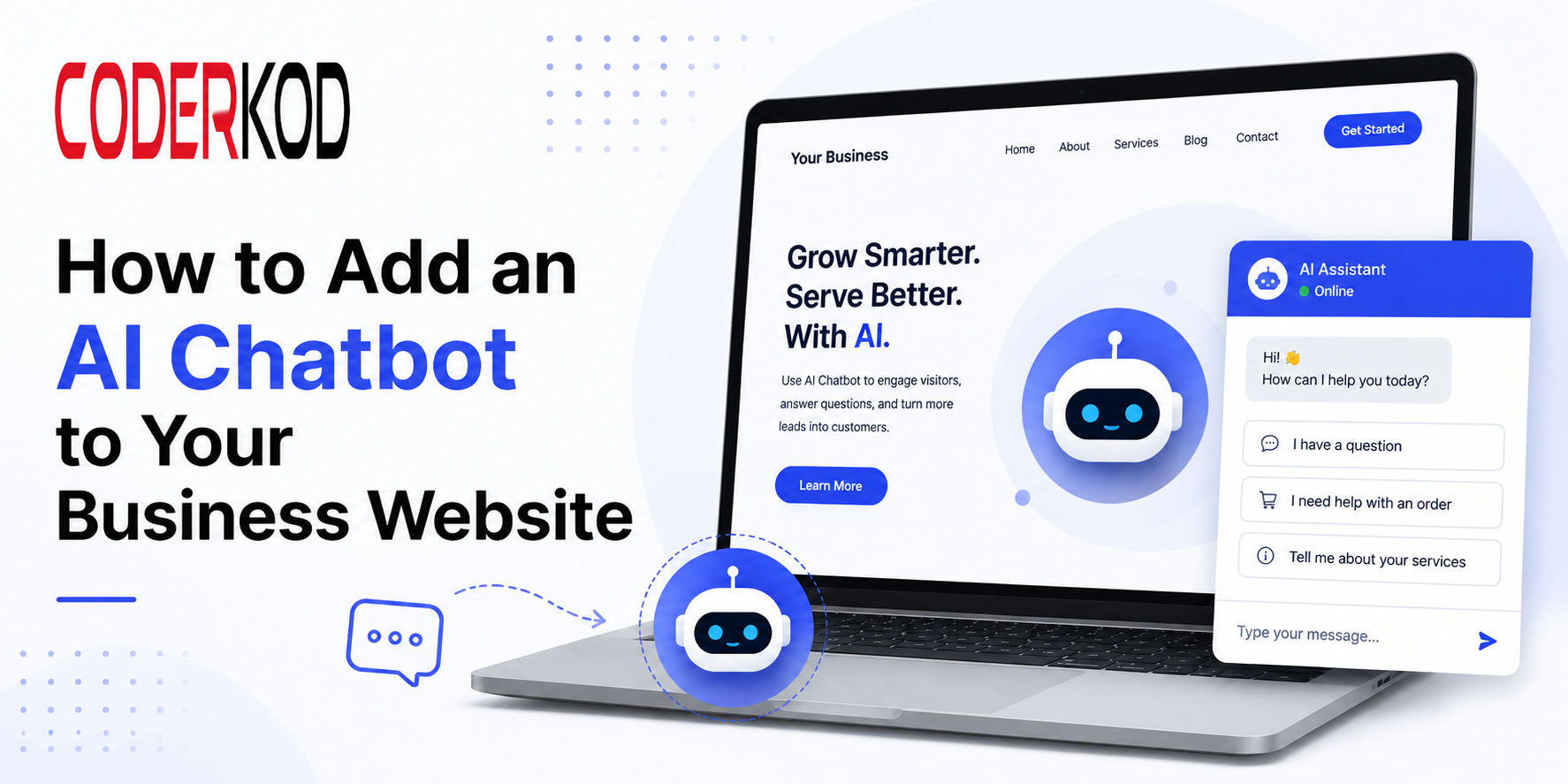
How to Add an AI Chatbot to Your Business Website: A Practical Guide for 2026

Every business owner has heard the pitch at least once: “Add an AI chatbot and watch your support costs drop by half.” The reality is more nuanced but the opportunity is very real. A properly built AI chatbot can handle repetitive customer queries, qualify leads before they reach your sales team, and help visitors find answers that are buried five clicks deep in your website.

A poorly built one, however, can frustrate visitors and quietly damage the trust your brand has spent years building.

At CoderKod, we’ve helped businesses across the USA, UK, Middle East, and Asia Pacific integrate AI-powered solutions into their digital products. This guide covers what actually works in 2026 without the hype.

First, Understand What Kind of Chatbot You Actually Need

Not every chatbot is built the same way, and choosing the wrong type wastes both time and money.

Scripted (rule-based) chatbots follow a fixed decision tree. A visitor clicks “Get a Quote,” the bot asks a few questions, and the data lands in your CRM. These are fast to build, predictable in behavior, and well-suited for narrow, repetitive tasks. Tools like Tidio, Intercom, or Drift handle this well. Budget: roughly $50–$200/month for the platform.

AI-powered (RAG-based) chatbots are a different beast entirely. These use large language models combined with your own content, your website pages, documentation, FAQs to answer questions in natural language. They handle questions you never anticipated. Budget: typically $1,200–$5,000 for the initial build, plus $80–$400/month in API usage depending on traffic volume.

If you run a service business with a rich knowledge base, an AI-powered chatbot is the right investment. If you’re a single-product business with straightforward sales flows, a scripted bot may be all you need.

The Architecture Behind Modern AI Chatbots

Most production AI chatbots today follow a pattern called RAG (Retrieval-Augmented Generation). Here’s how it works in plain terms:

Step 1: Index your content. Your website pages, help articles, and documentation get converted into numerical representations called vectors, then stored in a vector database (common choices include Pinecone, Weaviate, or pgvector if you’re already running PostgreSQL).

Step 2: Retrieve relevant information. When a visitor asks a question, the system finds the most relevant chunks of your indexed content and pulls them up as context.

Step 3: Generate a grounded answer. An LLM (such as Claude, GPT-4, or an open-source alternative) writes a response based on your retrieved content, not from its general training data. It can cite the source pages so the visitor can read further.

This architecture directly solves the “hallucination” problem that plagued early AI chatbots. Because the model is summarizing your content rather than generating from memory, fabricated answers become far less likely. If a question cannot be answered from your indexed content, a well-configured bot should say so and offer a human handoff.

What to Index and What to Leave Out

The quality of your chatbot is directly tied to the quality of what you feed it. More content does not mean better results.

Index these:

    • Help center and FAQ pages
    • Pricing and service detail pages
    • Product documentation and technical guides
    • Any page written to answer a specific question

Skip these:

    • General blog posts written primarily for SEO
    • Case studies and testimonials (unless they answer specific questions)
    • About pages, careers pages, and marketing copy that talks around topics rather than answering them

Marketing language bloats your index and drags retrieval toward fluffy answers when your visitors want specific, actionable information. The discipline of a clean index is what separates a chatbot people trust from one they abandon after two messages.

Common Mistakes That Kill Chatbot Performance

Bad AI is rarely the root cause of a failed chatbot. Bad UX almost always is.

Auto-opening after a few seconds. Interrupting a visitor before they’ve read a single paragraph is a guaranteed way to irritate them. Let visitors open the chat when they want it.

Requiring an email address before the first answer. This is the single most damaging pattern we see. Visitors leave immediately. Ask for contact information after the bot has delivered value — not as the price of admission.

Pretending to be a human. Naming your bot “Sarah” and assigning it a stock photo of a customer service agent is a strategy that backfires within seconds. Visitors recognize it, and they trust you less for trying to deceive them. Transparency about the bot being an AI assistant actually increases confidence.

No path to a real person. Even the best chatbot will hit its limits. A visible “Talk to a human” option must exist on every screen, and it must connect to an actual person within a reasonable time during business hours.

How to Know If Your Chatbot Is Working

Vanity metrics like “conversations started” or “questions answered” tell you nothing meaningful. Focus on these instead:

Deflection rate: Of visitors who asked the bot a question, how many did not then submit a contact form or raise a support ticket? For a B2B service business, anything above 40% is solid performance.

Conversion rate of bot users: Are visitors who interact with the chatbot more or less likely to become customers? If they are less likely, the chatbot is hurting your business, fix or remove it.

Hallucination rate: Sample real conversations every month and check for fabricated information. Even a single invented fact is a trust problem. Monitor this closely in the first six months.

What a Realistic Build Timeline Looks Like

For a service business with 50–100 indexable pages, a production-quality AI chatbot typically takes 3–4 weeks end-to-end.

Week 1 — Discovery and content audit. Identify the 20–30 most common questions your visitors actually ask. Audit your existing pages to see which ones answer those questions clearly, and write or rewrite the ones that don’t. This unglamorous groundwork determines 80% of the final quality.

Week 2 — Build. Set up the embedding pipeline, vector database, retrieval logic, LLM integration, and chat interface. Most of this work is infrastructure and plumbing.

Week 3 — Internal testing. Have your own team ask the chatbot the questions they field every day. Fix failures — which are usually caused by missing or unclear source content, not bad AI.

Week 4 — Soft launch and monitoring. Roll out a portion of your traffic, watch real conversations for the first few days, refine system prompts and retrieval thresholds, and then go live for all visitors.

Is an AI Chatbot Right for Your Business Right Now?

Not every business needs a custom AI chatbot today. If you’re getting fewer than 50 website visitors a day, a simple contact form and fast email response will outperform a chatbot in both conversion and trust. If you’re handling significant inbound volume — support questions, pricing inquiries, qualification calls — a well-built chatbot pays for itself quickly.

The goal is not to have a chatbot because competitors have one. The goal is to solve a specific customer problem: faster answers, better lead qualification, or reduced support load. Build toward the problem, and the technology becomes a real business asset.

At CoderKod, we specialize in building AI-powered web and app solutions for businesses that want technology to actually move the needle. If you’re ready to explore what an AI chatbot could look like for your business, get in touch with our team and give you an honest assessment before we talk about building anything.